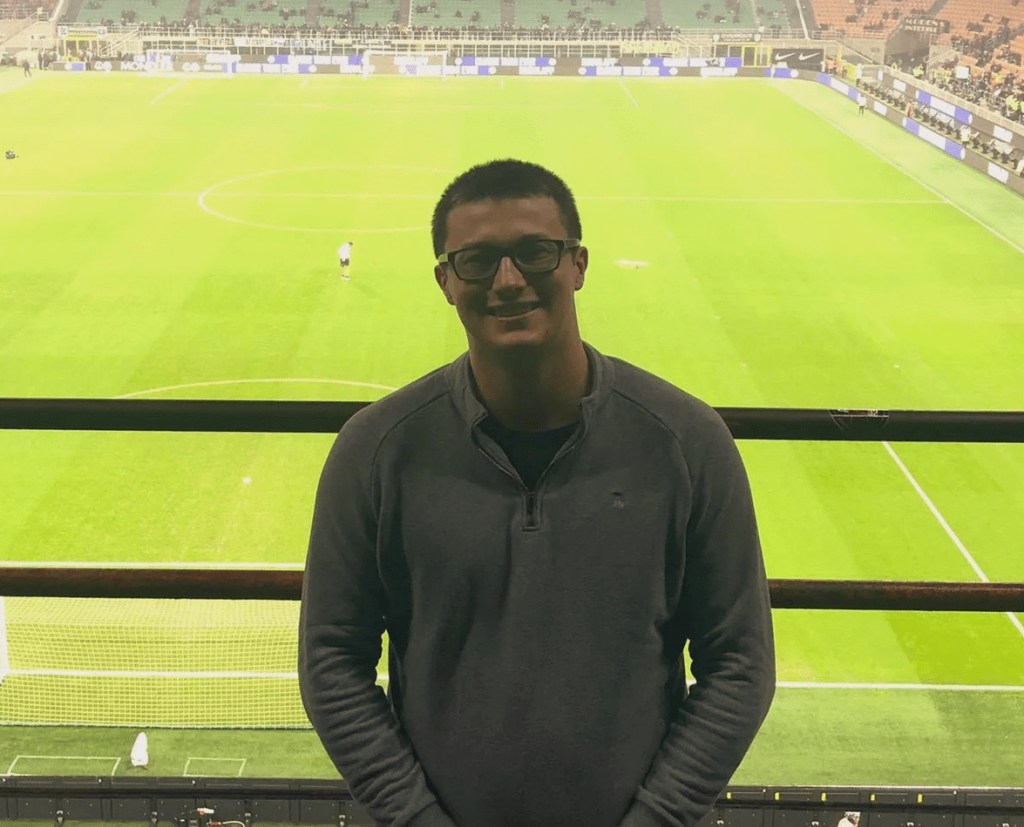
I recently had the pleasure of talking to Michael McCann, sports commentator extraordinaire. With nearly 10 years’ experience on the mic, and even more in the industry, Michael will be familiar to many for his work on women’s football on Dazn or the FA Player.

SheGulls: So Michael, thank you for taking the time to speak with us. Could you start us off with a brief overview of your role and how you are involved in the women’s game?
Michael: I’ve been reporting on women’s games in a written capacity from back in 2014, and commentating on the Women’s Super League on the FA player regularly ever since it was launched in 2019. In more recent times, I’ve also been a regular voice on the UEFA Women’s Champions League and Liga F for DAZN. I’ve had the privilege of commentating professionally on more than 150 Women’s Super League games in my career and many hundreds more on the men’s side as well. I’ve also broken various transfer stories, including confirming Geyse joining Manchester United from Barcelona in the summer.
How did you become a commentator and what has your journey been to this point?
Even as a teenager I was really interested in and enjoyed broadcasting, so I started doing community radio, recording my own stuff at home, then university radio, and eventually after years of doing that and getting your unpaid experience, those vital ‘flying hours’, I started getting professional opportunities and have done for almost a decade now.
How do you prepare prior to covering a match?
It’s an extensive process for me preparing to cover a game. Each match will need at least in a day and a half if not two days worth of work. It involves speaking to contacts from both teams and who know both teams well, detailed scouting of more reliable internet sources and then putting all of that information into my commentary notes template which is extremely detailed.
I always try to be ready for every eventuality of what might happen, and do my best to make sure every base is covered as much as you possible. Of course only a tiny percentage of this prep will be used in the game and what you use depends on the storyline of where the game goes. There’s a lot more to it all than what I’ve just mentioned but I could bore you all night about it!
Is there anything you do differently when covering the women’s game? Do you change your style or delivery?
This is an interesting question. The short answer is no. I treat every game the same, regardless of whether it’s men’s or women’s. It doesn’t change my processes, it doesn’t change how I prepare, it doesn’t change how I watch and analyse the game or as I see it and so I see no real reason to. All of the professional women’s athletes that I know have always told me that the last thing they want is to be treated any differently.
Many privately over the years have talked to me about finding it very disappointing about the way women’s sport can be covered in a patronising tone. I’ve always been adamant that I would always cover it the exact same way and I’ve never had anyone give me a good enough reason to not do so.

Is it difficult to balance your football knowledge in some of the more technical aspects of the game versus being more explanatory for younger or newer fans?
Of course it’s a challenge. Your question alludes to one of the most difficult aspects of commentary, which is trying to both give information that die-hard fans might find interesting, but also cater for viewers on a broadcast who might know very little about the two teams or the wider game. Ultimately what you’re trying to do is find a balanced medium between the two. This is certainly not simple, it’s the kind of skill that you develop over time doing a lot of matches and also having the very necessary painful process of listening back your own voice and picking apart your own commentary. It’s great to get an outside perspective on that, but also doing it yourself is key.
Do you have a plan or a particular strategy for handling a less exciting game?
In short, no, because I don’t really think of any particular game as being less exciting than another. If there’s a lack of goalmouth action that doesn’t necessarily mean the game’s less exciting because with ten minutes to go, if it’s nil-nil, even if there haven’t been many chances, it’s still all on the line. So, I think as a commentator, you’re always trying to anticipate when is that next big moment coming. Who’s likely to provide it and how’s it likely to happen?
If a tie is just perceived as less glamorous, then again, I don’t have any particular plan. It’s about finding the meaning, what’s at stake and the jeopardy in every game. There’s never a game that has absolutely none of those things, there’s always something on the line somewhere. Indeed, most of the time there’s far more than one thing.
What’s been your favourite ever game to commentate on?
On the women’s football side, I would say it would be Benfica vs Bayern Munich in the Champions League last season. 3 -2, incredible game. Benfica 2 -0 up and looking on for one of the best Champions League upsets ever. Then Bayern rescue it, Maria-Luisa Grohs makes probably the best penalty save I’ve ever seen live in my life to stop Benfica coming back, and then Georgia Stanway scores the winner in the 8th minute of stoppage time. It was completely breathless, and even though it was only a group stage game, it had the intensity of the knockouts. So, whilst it was not the most high profile match I’ve ever commentated on in women’s football, in terms of entertainment, chaos, goals, drama, it would be the one for me.
Any embarrassing moments or memorable mishaps you’d be willing to share?
Good question. One key part of being a professional live broadcaster is accepting that you are a human being, you will make mistakes and you will misspeak, and in those situations have a quick laugh at yourself and move on.
One particularly funny one that comes to mind is when the lethal duo of Fran Kirby and Sam Kerr was starting to form and everyone was referring to them as ‘Kerrby’. I was talking about that combination and inadvertently called them Fran Kerr and Sam Kirby. I had a good laugh at myself at the time and obviously corrected it immediately. I know it was something that quite a few Chelsea fans had a good chuckle over at the time and a few friends of mine who are Chelsea supporters had a bit of a laugh with when speaking to me about it afterwards.
Is there anything you aspire to in the future in terms of working in the media or even life goals?
One thing that sort of fuses those two questions together and that’s a real sense of purpose for me is helping to make the sports media space more welcoming to people from a range of diverse backgrounds and minority groups.
I came out three years or so ago as being part of the LGBT community and being bisexual. When I was 12 years old, I’d already figured out that I wanted to work in sports, but I also knew that I was not straight and had already started to notice how toxically masculine sport often was and could pick up on the fact that it wasn’t a very friendly place to not be straight. I really don’t want other people at that age to have the years of insecurity that I had around that and in recent times women’s football has been great as being a space where I can be openly, fully, comfortably myself.
I’m a proud member of Sports Media LGBT+ and wherever I can, I do what I can to represent openly and physically on that front but it’s not just about that for me. I have done various work around discrimination charities that I’m proud of and also helping to encourage young women to get into the industry because ultimately there’s still a lot of change that needs to happen on so many different intersectional levels.
What is your opinion of Brighton & Hove Albion Women’s team? Do you see development? Improving standards?
My opinion of Brighton and Hove Albion women’s team is that I think there’s a lot to be proud of with what the club has done over the years. The building of the new bespoke training facility is a real statement of intent in terms of seriously supporting the women’s team.
I do see development for Brighton, though the whole league across the WSL is improving year on year, so that always makes it very tough because whilst a club might be improving everyone else is around you too, at quite a rapid rate.
I think a club like Brighton should obviously first and foremost want to make sure each season that their WSL status is secured, but also really dream big of a deep run in either of the cup competitions. That is a great opportunity to potentially go and win a trophy.
I’d say it’s always going to be tough for a club like Brighton to compete against the so-called established big four, but I think there’s a huge amount to be positive about in the way that Brighton have run their operation over the years. It’s shown a real clear commitment to the women’s game over an extended period of time which a lot of men’s clubs in the top two tiers of the men’s club have not really shown at all.
We thank Michael again for his time and you’ll hear his dulcet tones on all your favourite women’s football outlets with regularity as well as many other sporting events coming soon! Always a fascinating follow, you can catch him on X/Twitter via the handle @ThisIsMcCann

 SHEGULLS - BRIGHTON & HOVE ALBION WOMEN FANS
Leave a comment